Access to justice is more than a theoretical, lofty ideal. It is boots-on-the-ground work being done every day by dedicated Michigan attorneys through pro-bono or reduced fee services, including our legal aid providers, and by judges and court staff incorporating administrative changes including providing computers for use by the public, revising court forms to make it more understandable for pro se litigants, and allowing for virtual participation when appropriate. It is also part of the State Bar of Michigan’s core mission — and, for many of us, a driving aspirational force behind our own decision to become lawyers.
The Michigan Supreme Court’s Justice for All Commission, which evolved from the Michigan Supreme Court’s 2020 Justice for All Task Force, is focused on one clear yet very ambitious goal: ensuring that Michigan provides 100% access to our civil justice system. It brings together leaders and partners statewide to intentionally, collaboratively, expand access to justice. Stakeholders include the judiciary, legal aid providers, bar associations, community organizations, libraries, other public-serving institutions, and the State Bar of Michigan.
As part of the Justice for All Commission, I recently had the opportunity to travel to Washington, D.C., to talk with Michigan’s congressional delegation about the important work being done through funding for the Legal Services Corporation (LSC), a nonpartisan organization created to protect the rights of all Americans by funding civil legal aid programs in every state, and why support for LSC funding is essential to address the nationwide justice gap (including Michigan).
Michigan’s legal aid programs provide free advice and representation to those who can’t afford to hire a lawyer when civil legal problems threaten basic living needs including access to safe housing, protection from domestic violence, and financial stability. Their clients are often families, seniors, veterans, people with disabilities, and those living in poverty.
The outcomes in Michigan speak for themselves: 99% of housing cases resolved successfully, 92% of family stability matters improved, and 97% of expungements achieved positive results. These are not just statistics — these numbers represent real people, real stability, and real opportunity.
The need for services far outpaces available resources. Nationally, LSC-funded organizations must turn away nearly half of the approximately 4 million requests for civil legal assistance each year.
In Michigan, the need is particularly stark. Only 7% of the civil legal problems faced by low-income residents receive adequate legal help. This is not a reflection of a lack of commitment — it is a reflection of insufficient resources. If we are serious about closing the justice gap, sustained and increased investment in civil legal aid, including LSC funding, is essential.
However, LSC is far from guaranteed. This year, LSC funding was cut by $20 million to $540 million to fund legal aid programs nationwide in FY 2026. While it represents a 3.6% decrease in funding, we are thankful that funding was largely maintained despite proposals to essentially eliminate funding for legal aid programs.
This is why I found myself in Washington, D.C., traveling with a non-partisan group of passionate advocates for access to justice, which also included Jennifer Bentley, executive director of the Michigan State Bar Foundation; Calhoun County Circuit Court Judge John Hallacy; Wendy Richards, principal and pro bono counsel at Miller Canfield; Nathan Triplett, SBM’s director of government relations; and Michigan Supreme Court Justice Brian Zahra, chair of the Justice for All Commission.
It was a whirlwind three days in D.C. We arrived on Tuesday and those of us who had the time attended a forum on Increasing Access to Justice. Specifically, the topic was “Making America’s Promise Real for Veterans and Survivors of Domestic Violence.” Later, we had the privilege of attending a Justice for All Reception at the Supreme Court of the United States, hosted by LSC, where we had the opportunity to hear timely and motivating remarks by Justice Ketanji Brown Jackson. The second day began at 8 a.m. when we headed to our Headquarters on the Hill. We met with Michigan members of Congress and Senate and/or their staff, with the last of our 12 meetings taking us to 6 p.m., when we headed to a reception hosted by the American Bar Association. On our third, and final, day, our team attended a couple more meetings on Capitol Hill before returning home to Michigan.
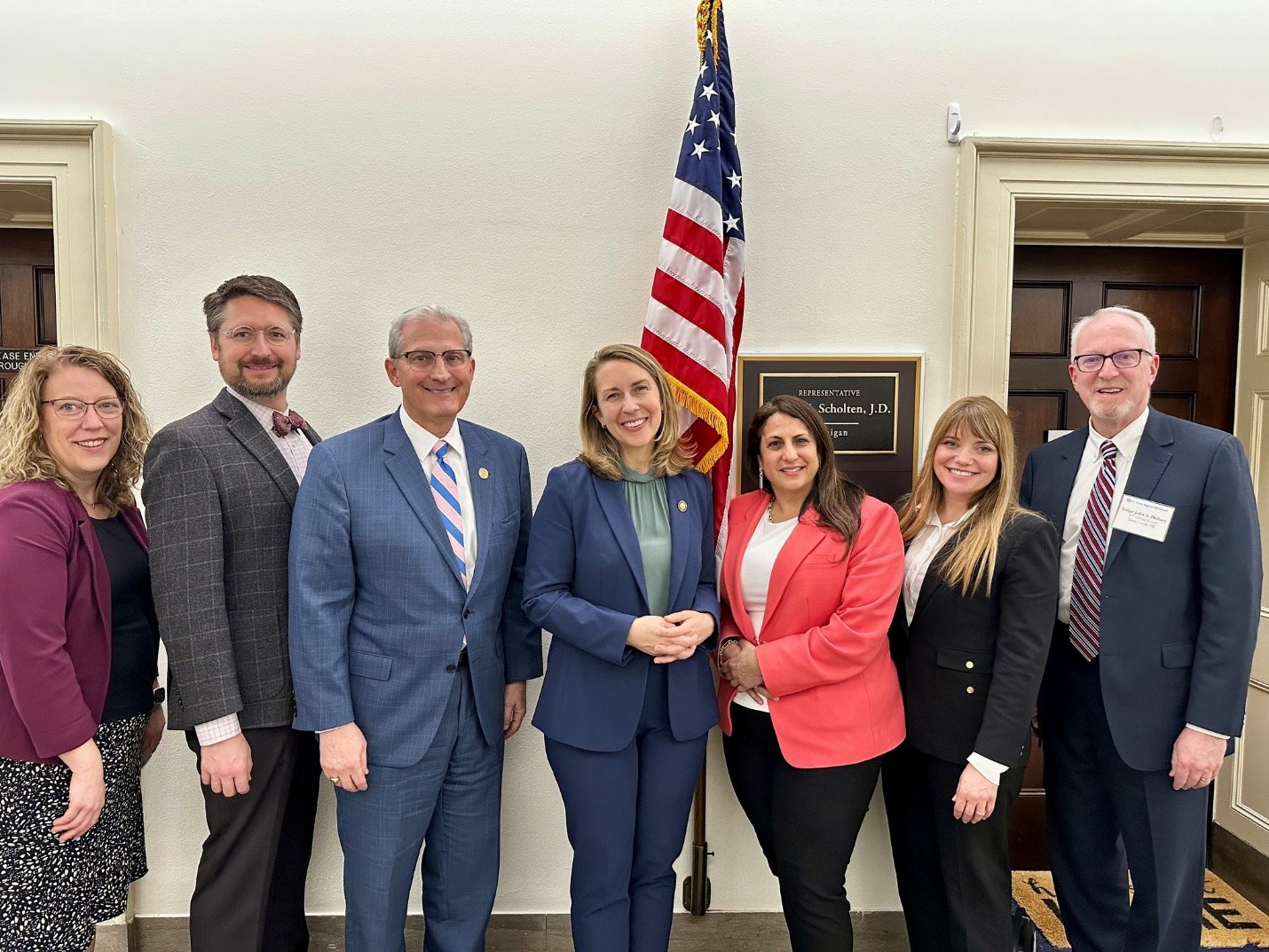 |
| A team of representatives from Michigan’s Justice for All Commission went to Washington, D.C. in March to tell our Michigan Delegation why funding for legal aid is so important. Pictured (left to right) Jennifer Bentley, executive director of the Michigan State Bar Foundation; Nathan Triplett, SBM’s director of government relations; Michigan Supreme Court Justice Brian Zahra, chair of the Justice for All Commission; U.S. Rep. Hillary Scholten, also a Michigan attorney; SBM President Lisa J. Hamameh; Wendy Richards, principal and pro bono counsel at Miller Canfield; and Calhoun County Circuit Court Judge John Hallacy. |
The trip was a great success, and our group was able to share important information about why support for LSC is critical to upholding access to justice. As Texas Supreme Court Chief Justice Nathan Hecht said at one of the forums: “Judges can’t simply be umpires when one team is forced to play without bats.”
We greatly appreciate Congress’ longstanding support for the Legal Services and for largely preserving this essential service — especially the nonpartisan support of Michigan’s U.S. Senators and Representatives.
I want all my fellow attorneys to know how critical their support is as well. We need your help, both in words and in action:
Help us reinforce the message about how important LSC funding is by talking to your own local congressperson and our U.S. Senators. Boots on the ground are only part of the need.
And, help us fund legal aid services by contributing to the Access to Justice Campaign.
Administered by the Michigan State Bar Foundation in partnership with the State Bar of Michigan, 100% of donations to the Access to Justice Campaign goes directly to providing services. Just as importantly, it demonstrates our legal community’s commitment to work for access to justice. It acts as our skin in the game to prove that we, too, are stepping up to the plate to support this important work.
In 2025, our legal community contributed $1,202,614 to help make a difference. This funding significantly increases the services available here in Michigan.
However, the recommended minimum donation for Michigan attorneys is $300, and $500 for those with financial means to give more. There are 35,000 active attorneys in Michigan; We can and should be giving more. Consider giving today at atjfund.org.
The promise of equal justice under law is one of the most enduring principles of our legal system, but it is not self-fulfilling. It depends on the structures we build, the resources we commit, and the collective will we bring to ensuring that justice is truly accessible to all.
Michigan has made a clear commitment to meeting this challenge. The goal of 100% access to justice is ambitious, but it is also achievable. Through the work of the Justice for All Commission, and with continued collaboration and sustained investment — particularly in critical funding streams like LSC and our own contributions to the Access to Justice Campaign — we can move closer to a system where access to justice is not determined by circumstance but guaranteed as a matter of right.