John Barkai, Michigan Rules of Evidence Handbook—With Common Objections & Evidentiary Foundations (2026), with BarkaiBots access. Available at Amazon, $12.99, 6” x 9” paperback, 133 pages, including the rules and advice on using them in the courtroom.
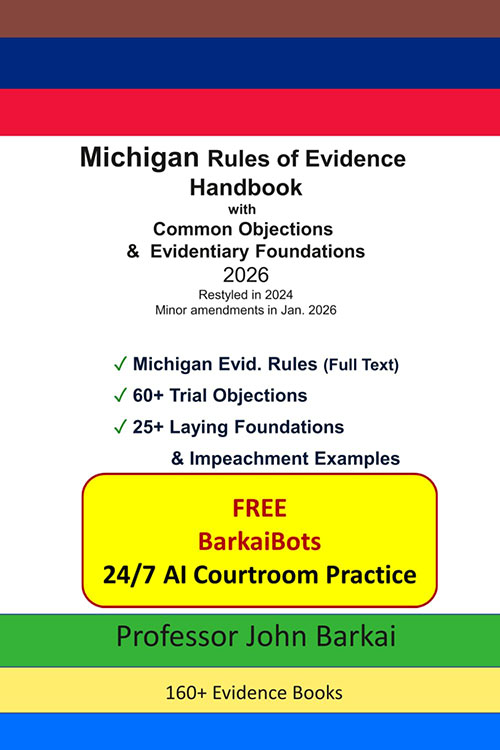 |
Written by John Barkai
Independently published
Hardcover|133 pages|$12.99 |
Professor John Barkai has been on the faculty of the University of Hawaii’s William S. Richardson School of Law in Honolulu’s Manoa Valley for decades—but his roots are in Michigan. Barkai is an evidence maven and now the creator of BarkaiBots, a unique, AI-powered, computer-delivered, on-demand, self-operated, no-cost, interactive, customizable, simulations-based, practical evidence-skills training program.
Readers of Barkai’s Handbook1 can use BarkaiBots to practice and refine their courtroom skills before they are called on to examine witnesses, make and respond to objections, present evidentiary foundations, and meet other needs in the heat of trials, depositions, and other adversarial undertakings.
I will review the Handbook and acquaint you with BarkaiBots, but first I establish the requisite evidentiary foundation and make disclosures.
FOUNDATION AND DISCLOSURES
Barkai grew up in Detroit and earned his J.D. and two other degrees from the University of Michigan. We were law school classmates and took the Michigan bar together. There was no multistate exam then. As I recall, the bar was 2 and 1/2 days of essay questions, which we answered in bluebooks using number 2 pencils. We passed.
Barkai practiced as a public defender in Detroit and then became a Wayne Law professor. He later migrated to Oahu to be a professor in paradise. Since then, Barkai has been a font of practical wisdom for legions of U-H law students and many Aloha State lawyers and judges on evidence, trial advocacy, negotiation, and dispute resolution.
Barkai should remember that his sustained professional success is in great part due to my example and tutelage at law school, then when we were Detroit criminal lawyers, and later when we were faculty colleagues at Wayne Law and U-H Law during my semester as a visiting professor. But Barkai’s memory of my influence is dim. Sunstroke, probably.
Oh, well, Barkai deserves some credit. He is an evidence maven, as noted, and he now is the genius behind the eponymously named BarkaiBots. My favorable review of his Handbook and BarkaiBots is totally objective. Totally. It is not influenced by our long-time association and will withstand MRE 702-704 scrutiny.
BARKAI’S EVIDENCE-HANDBOOK SERIES
The Michigan Handbook is one of a series of similar Barkai-authored evidence handbooks. The series covers many jurisdictions that have rules modeled on the Federal Rules of Evidence, or that use similar evidence principles and procedures. The series covers all states, federal and military courts, and other U.S.-affiliated jurisdictions (like American Samoa, the Federated States of Micronesia, Guam, Palau, and Yap).
The series also covers jurisdictions in Canada, Europe, Asia, and Africa (like the U.K., Australia, New Zealand, Papua New Guinea, Fiji, Hong Kong, the Philippines, Bangladesh, Sri Lanka, Taiwan, Nigeria, Zimbabwe, and India).
All the handbooks are listed in the Michigan Handbook at pp. A-80 through A-81. If you plan to travel in the U.S. or abroad to places where evidence questions might come up, like Puerto Rico or the Cook Islands, look at Barkai’s Amazon page and get prepared. If, however, the only islands that concern you are Belle Isle, Mackinac Island, and various coney islands, get the Michigan Handbook for its stated purpose: to be “at your side” when needed.
EVIDENCE RULES AND TRIAL TECHNIQUES “AT YOUR FINGERTIPS”
For years, I carried a small paperback edition of the FRE in my briefcase. I used it in the heat of legal adversity in courtrooms, labor-arbitrations, and at depositions. I used it to refresh my recollection (or the judge’s, the arbitrator’s, or the other side’s) about what the evidence rules actually require. My instant access to the rules occasionally gave me an advantage over others, who maybe missed a law school evidence class or two or dozed off and never quite mastered some rule that didn’t seem important in class, but later became quite important in a “proceeding.”
Now, with Barkai’s Handbook in your briefcase, you can have the MRE, plus model techniques and practical advice, to give you an evidentiary edge. The Handbook might remind you during a 15-minute trial recess, say, that “Michigan is one of 12 states that does NOT have a learned treatise hearsay exception.”2 Compare MRE 803(18) to FRE 803(18). You can consider MRE 707, return to court, and object to the treatise-reliant opinion of your opponent’s self-important “expert.”
RULES, TECHNIQUES, ADVICE, ACRONYMS, AND MORE
The Handbook has the full text of the MRE and much more. It includes advice on “making and responding to common objections,” covering why (and why not) to object, how to object, how to respond to objections, how judges consider objections, the MRE 103 “key” to objections, offers of proof, motions in limine, preserving evidence-ruling errors for appeal, more than 60 “common objections,” and additional “voice of experience” information to help you make informed tactical decisions. It will help you deftly use terminology anchored in the MRE, and be prepared for, say, a judge asking for the precise basis of your objection or dealing with opposing lawyers’ improper use of “speaking objections” to coach their witnesses or obstruct your witnesses.3
The Handbook offers concrete models and practical advice on setting evidentiary foundations, recognizing deficiencies in the other side’s foundation efforts, introducing exhibits and moving their admission, impeaching witnesses, refreshing memory, making offers of proof, and presenting expert opinion. The Handbook covers many specific contexts, like presenting (or objecting to) evidence in the form of deposition testimony, ESI, phone calls, voicemail, email, texts, social media, website content, and more.
The Handbook offers “useful points” about public and business records, computer records, documents that contain double hearsay, demonstrative evidence, and chain of custody. The Handbook lists “important evidence rules” that will guide your preparation and your evidence-related trial efforts.4
Barkai offers helpful mnemonic devices and acronyms—as law professors are wont to do. Remember IRAC (Issue, Rule, Analysis, Conclusion)? One of Barkai’s devices, pertinent to assessing the admissibility of paper and electronic documents and presenting the requisite foundation,5 is HARROW:
Hearsay (MRE 800s)
Authentication (MRE 900s)
Relevance (MRE 401)
Relevance (MRE 403)
Original Writings (best evidence, MRE 1000s)
Another, pertaining to MRE 803(6) and “business records,” is KRAP: Kept in the course of Regularly-conducted activity, made At or near the time of the subject matter, based on someone’s Personal knowledge.6 Another is OTP: lawyers considering the relevance, admissibility, and necessary foundation of evidence they plan to present should also consider what the evidence will be Offered To Prove.7 Barkai’s acronyms provide checklists to help avoid evidentiary SNAFUs and, more importantly, FUBARs.
THE HANDBOOK’S UNCOMMON VIRTUES
Barkai’s Handbook, unlike many evidence tomes, is action-oriented. It is designed to help lawyers prepare effectively, avoid problems, and solve problems if they arise. The Handbook is succinct, readable, practical, and inexpensive.
The Handbook makes the important point that evidence-proficiency requires more than knowing the rules. You must be attuned to the “local legal culture,” whether learned experientially or by study. Michigan’s civil procedure rules, for example, though modeled on the federal rules, label as “summary disposition” what federal courts and most other jurisdictions call “summary judgment.” Out-of-state counsel often ask about this idiosyncratic terminology. Summarily speaking, is it better to dispose than to judge?
I add that you might strive to master local pronunciation. Is it “vwah dear” or “vore die-er”? I add, too, that you might want to become acquainted with the predilections of the local judges who will control your clients’ legal fates.
In Barkai’s and my formative years, many judges applied the perhaps facetiously named Detroit Recorder’s Court Hearsay Exception. It was unwritten, imprecise, unevenly applied, and sometimes troublesome. It was reminiscent of the definition of the word lawful in Ambrose Bierce’s The Devil’s Dictionary (1911): “Compatible with the will of a judge having jurisdiction.”8 Basically, the exception admitted into evidence, for truth, virtually any out-of-court statement made in the presence of the on-trial criminal-defendant. Later, while working in Columbus, Ohio, I heard this same “in the presence” hearsay “exception” called the Franklin County Hearsay Exception.
I practiced as a labor lawyer for some decades, in a culture that tolerates arbitrators avoiding immediate rulings on evidence disputes. Arbitrators often admit—”for what it’s worth”—hearsay, opinions without foundation, and other “fluff and flowers.” This keeps hearings moving, unobstructed by a bunch of legal-type stuff. Litigants find out what, if anything, the “evidence” is worth months later, when they get the arbitrator’s “final and binding” decision. Barkai notes a similar court phenomenon, accounting for evidentiary rigor in jury trials, less in bench trials.
Barkai thinks that unwritten rules like the Recorder’s Court Hearsay Exception may be the progenitors of MRE 801(d)(2)’s situational tolerance for adoptive admissions. Whatevahs, as they say in Hawaiian pidgin. Unwritten rules are enforceable in the “local culture” if judges think they are rules.
BARKAIBOTS BENEFITS
New in the current Handbook is an introduction to BarkaiBots, Barkai’s unique, AI-powered, computer-delivered, on-demand, self-operated, no-cost, customizable, simulations-based evidence-skills training program. BarkaiBots is a mentor ex machina at your service. You can master the skills needed to apply the evidence rules, and do it in the comfort of your home, in your spare time, at your own pace. No more CLE classrooms, no more fat, expensive books, no more law professors’ dirty looks.
The word BarkaiBots, I think, is both singular and plural, like sheep, aircraft, and haiku. Anyway, the Handbook explains, BarkaiBots provides “24/7 interactive AI courtroom simulations that function both as responsive practice partners and built-in personal coaches to help users improve their advocacy,”9 I add, to hone their evidence instincts. As Archimedes put it: “Eureka!”
BarkaiBots provides the evidentiary acumen needed for effective direct and cross-examination, impeachment by inconsistent statements, dealing with evasive witnesses, laying foundations, making and responding to objections, and more. In this age of “vanishing trials,” whether you are a sophisticated “been there, done that” litigator, an inexperienced lawyer, or a law student, chances are that BarkaiBots will enhance your skills and teach you something new and useful.
There’s more! Users can customize BarkaiBots simulations by uploading their own “fact patterns”—using their “desktop, laptop, phone, or tablet”—and then use BarkaiBots to “rehearse, receive coaching, and refine their advocacy” with tailored practice, aided by AI witnesses, judges, and opposing counsel who pick up the customized facts. BarkaiBots pays attention to your facts and will provide informed real-time feedback.
Users can record their practice efforts on Zoom or otherwise—for later self-assessment, or to screen their practice performance for colleagues eager to provide constructive criticism on substance, theory-of-case consistency, clarity, order, pace, word selection, nonverbal distractions, ill-advised fashion choices, etc. You can do all this before you step into the courtroom. As the old joke goes:
Tourist: “Excuse me, how do I get to Carnegie Hall?”
On-the-street sage: “Practice, practice, practice.”
As the Handbook instructs, you connect to the “Amazon BarkaiBots Start Page” by using the web address or the QR code on page A-84. When you connect, you will find a user guide, links to current BarkaiBots simulations, and more. You will need a free online account with ChatGPT, or a paid ChatGPT Plus account, and an email address. If you have my limited technological ability, to start, you might need helpful advice from a teenager.
Creating BarkaiBots, Barkai drew on his “more than 50 years as a full-time law professor teaching evidence, clinics, simulations, and externships.”10 Experience taught him the benefits of extensive practice and structured coaching, both in short supply in law schools and many practice settings. Barkai observes that effective advocacy is “performance” enhanced by practice, done “aloud and repetitively,” focused on “timing, question sequencing, witness control, responsiveness to new information under pressure, and practical application of the evidence rules.”11 With the Handbook and BarkaiBots coaching, you can DIY—do it yourself.
CONCLUSION
The Michigan Rules of Evidence are intended to ensure that “every proceeding” is “administered fairly” and without “unjustifiable expense and delay” to the “end” of “ascertaining the truth and securing a just determination.”12
Fairness, economy, efficiency, alacrity, truth, and justice. Nice. What is to be done? Read Barkai’s Handbook and use BarkaiBots to practice, practice, practice. As they say in Hawaii, pomaika’i— good luck.